Friday, January 24, 2020

The Wallace Collection in Marylebone

24 January, 2020:

Some days ago, Eddie took me to see the Dennis Severs' house in Spitalfields.  Neither of us knew what to expect.  A man emerged from the front door and announced that the house was best experienced in silence, that no photographs were allowed, and that there was no information inside to explain what we'd be viewing.  He then added that the entry fee was cash only, of which we had none. That's when Fiona from Marylebone, who was standing directly behind us in queue, insisted on paying our fee.  Fiona recommended approaching the exploration of the Severs' house as an opportunity to "enter inside a painting."  It was indeed an immersive experience.  We later repaid Fiona and she shared some of her favorite places in London to see.  The Wallace Collection was one.

The Wallace Collection of art, inside Hertford House on Manchester Square, is free to enter.  The collection is of fine and decorative arts from the 15th to the 19th century, with important holdings of French 18th century paintings, furniture, arms and armour, porcelain and "Old Master" paintings.

Hertford House was the London home of Sir Richard Wallace (son of the 4th Marquess of Hertford) until his death in 1890.  Lady Wallace, Richard's widow, remained in the house until her death in 1897 at which time it was bequeathed to the state.  It opened as a museum in 1900 to display the many objects of art they had accumulated throughout their lives.

There is an abundance of art in the rococo style to be found in this grand house. Rococo is an art form which flourished under Louis XV and Madame de Pompadour during the mid to late 1700s.  It comes from the French, meaning rocky ground or loose stones.  The style explores symmetrical natural shapes wih fountain imagery, foliage and flowers, swirling scrolls and sea animals.  The collection also includes several personal effects and furniture once owned by Marie Antoinette.


Hertford House on Manchester Square

Entry Staircase


The Swing by Jean-Honore Fragonard, 1767


Head of John the Baptist, Italian, Unknown Artist, Circa 1500

Madame de Pompadour, Mistress to King Louie XV, 1759
Rembrandt Self-Portrait, Circa 1637

Flowers in a Vase, Jan Van Huysom, Circa 1726

The Laughing Cavalier, Franz Hals, 1624

Sunday, January 19, 2020

This Weekend's Outing to Brick Lane

Singaporean Food Stall, Brick Lane
Sunday, January 19, 2019:  This weekend, both of us feeling better, we ventured further afield and visited some of London's unique neighborhoods.  Saturday we found ourselves in trendy and edgy Spitalfields in East London where we explored its famed street markets.  Brick Lane is a vegan-friendly food paradise and Spitalfield's Market is mostly clothing.  We got lunch from the above Singaporean food stall ... it was scrumptious!

Olives and Turkish Delight, Brick Lane

Moooshies Vegan Burger Bar, Brick Lane

Inside an All-Vegan Food Hall


Christ Church, Spitalfields, dating from around 1714

Entrance to Spitalfield's Market
Sunday we visited Blackheath, in Southeast London.  Several places we have visited in London I have heard described as village-like, but Blackheath is the first place that resembled and felt like a village to me.  It is surrounded by expansive green fields, known as Blackheath Common.

Blackheath

Blackheath
On our way home we stumbled upon Buckingham Palace.
Buckingham Palace at Dusk


Friday, January 17, 2020

St. Paul's Cathedral

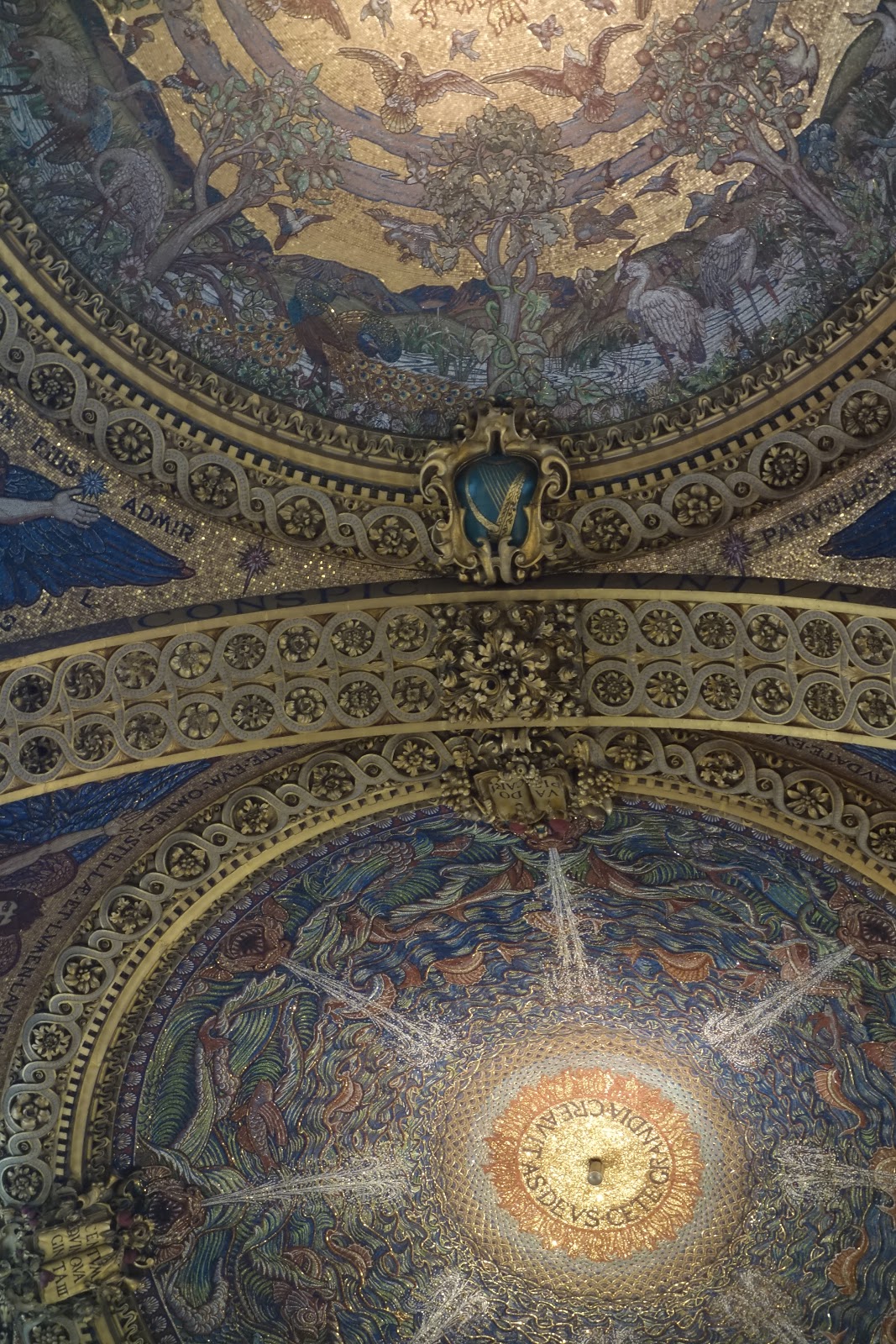
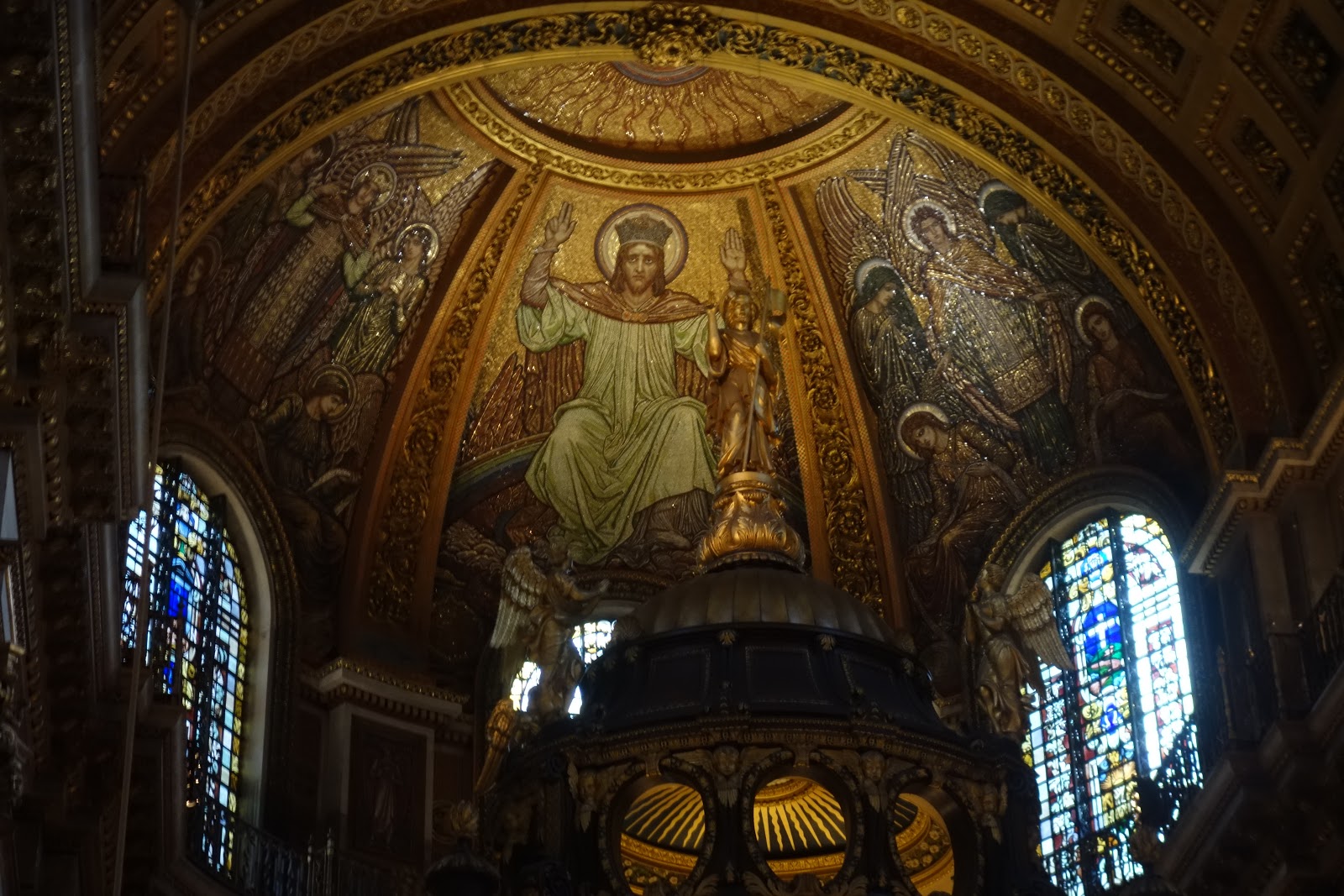
Friday, January 17, 2020: Today Eddie and I spent most of the day exploring the spectacular St. Paul's Cathedral.  Fortuitously, we were able to join a 90-minute tour of the building because, in hindsight, one can't truly appreciate this magnificent building without a proper introduction.  St. Paul's has been on this exact site for 1400 years, established in 604 AD.  There were several St. Paul's, each one destroyed one way or the other, including the great gothic building that burned in the Great Fire of London in 1666. The present cathedral was built in the late 17th century by the architect Christopher Wren.  When this cathedral was constructed, no one knew what an Anglican cathedral looked like or should look like, except that the architects and clerics did not want St. Paul's to resemble a Roman Catholic church.   The building has an interesting history. Princess Diana and Prince Charles married here.  There are numerous notable people buried in the crypt, including the artist Frederic Leighton and the Duke of Wellington (both of whom are mentioned earlier in this blog), as well as the architect Christopher Wren.  Eddie tried to get me to climb the 528 steps to the balcony that circles the exterior of the upper dome, but it was too much for me.  Once he came back down, he told me how challenging it was, but that the view was amazing.  The cathedral was bombed during WWII, but damage was minimal.


John Donne, Poet and Dean of Saint Paul's Catherdral


Spiral Staircase by Christopher Wren


Tombs of Wren and Leighton


Memorial to Florence Nightingale

Memorial to William Blake, Poet and Mystic


St. Paul's from the Millennium Bridge


The Shard Building on the South Bank of the Thames

One Blackfriars Tower by Blackfriars Bridge